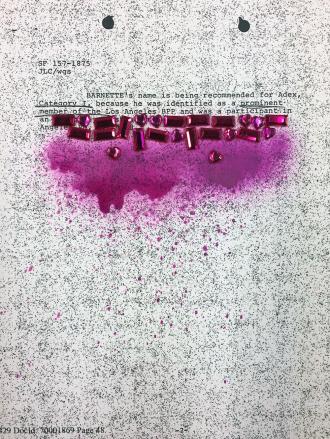
I just read about Sadie Barnette’s work Do Not Destroy (an excerpt is above) where she made an art installation out of the 500 pages of the FBI surveillance file of her Black Panther father. She decorated the pages like a little kid would, with bright paints, sequin and glitter, making beauty out of the stone cold truth of how the government criminalized her beloved father.
That got me thinking more about COINTELPRO and the first time I came across the term counterinsurgency which in turn led me to an organization set on defeating the counterinsurgency.
It was when I read Agents of Repression: The FBI’s Secret Wars Against the Black Panther Party and the American Indian Movement by Jim Vander Wall and Ward Churchill. The book details J. Edgar Hoover’s COINTELPRO (counterintelligence program) and the way it set out to discredit and dismantle both organizations including the instigation of violence which resulted in the imprisonment of Leonard Peltier who is still in prison to this day. In 1967, the FBI had determined that the Black Panther Party was “the greatest threat to the internal security of the United States.” It describes all the events leading up to the murder of beloved Black Panther leader Fred Hampton, only 21 years old when he was drugged and murdered in his own bed by the Chicago Police under FBI direction.
The book had a profound influence on me and helped me understand that revolutionary struggles led by Black, American Indian, Mexican and other peoples in the 1960’s were attacked militarily by the U.S. government. And I also understood that most of the white left was chillingly silent about the repression.
The book’s publisher South End Press was located in Boston and that was part of my impetus for moving there. They were known for publishing books written by political activists notably Noam Chomsky, bell hooks, Winona LaDuke and Howard Zinn. I thought maybe I could work there.
I didn’t get a job at South End Press. But while in Boston, I witnessed the miserable living conditions faced by African and Puerto Rican people in Roxbury and Dorchester. Young people kept getting killed by each other. And there was no historical context ever given in the news. Also, the infamous “Stuart Case” took place while I was living there. It turned out that this white man named Charles Stuart, in an effort to cash in on thousands of dollars of life insurance money, killed his pregnant wife while they were returning from a childbirth class driving through the black community of Mission Hill. He blamed the killing on a black man with a “raspy voice.” Mayor Flynn called out the Boston Police Department which subsequently raided the entire community, strip searching black males left and right who “fit the profile.”
I interviewed a woman named Hattie Dudley who was a leader in the Mission Hill community. The interview, “Boston’s War on Blacks,” was published in a college magazine called Blast put out by two Harvard undergrads. The experience of interviewing this woman changed me. Hattie Dudley was a powerful witness to the police assault on the young black men in her neighborhood. It was clear many people looked to her as mother figure, a protector, a leader because she looked after her community. Black men in their teens to twenties and even into their thirties had been made to strip and given body cavity searches. The entire Mission Hill community was subjected to public and private humiliation because of the words of one white man.
(Wikipedia says that a reality tv show took ” dramatic footage of the couple being extricated from the car.” I didn’t even know there was reality tv back in 1989? What the hell?!)
Later Stuart’s brother, who said he was in on getting the money but didn’t know about the murder confessed and a day later Charles Stuart jumped off the Tobin bridge.
The whole incident helped me understand the depth of the war on African people in the U.S. which continues to this day. It also helped me understand the lengths to which some white people will go to make to try to make a buck, even to the point that they’ll self-destruct.


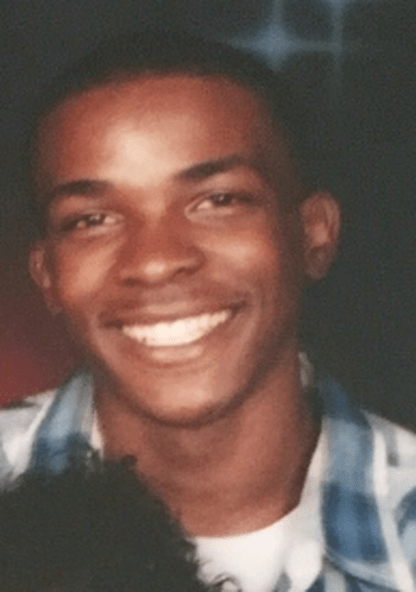 , right in the family’s backyard. The officers fired twenty times with no warning.
 Wendy Lea Writing